

Amsterdam Property Market 2026
Published • Wed, Jan 7, 2026

How Amsterdam's evolving property market affects serviced apartments, corporate housing, and temporary accommodation.
The Amsterdam housing market has undergone a major transformation since the explosive growth of 2021-2022. After years of record-breaking price increases, 2025-2026 has brought stabilization — but the consequences continue to affect the rental market, especially for expat housing in Amsterdam and people looking for temporary accommodation.
This guide analyzes what is happening in the Amsterdam housing market and what it means for professionals, expats, and companies searching for flexible corporate housing solutions.
Amsterdam Housing Market 2026: The Current Situation
Key Market Indicators (February 2026)
The frenzy of 2021-2022 — when Amsterdam housing prices rose by 21% annually — has cooled significantly. The market has entered a stabilization phase driven by higher mortgage rates, stricter lending standards, and improved (though still limited) housing supply.
What has changed since 2022:
- Mortgage interest rates have more than doubled (from 1.8% to 4.2% for a 20-year fixed rate)
- House price growth has slowed to near-normal levels
- Rental market pressure has shifted from a “crisis” to “very challenging”
- Demand for corporate housing has increased due to remote-work policies
- New construction projects are finally being completed
Housing Price Trends: From Explosion to Stabilization
The Peak of 2021-2022
Between January 2021 and January 2022, Amsterdam housing prices rose by an unprecedented 21.1% — the fastest growth ever recorded by Statistics Netherlands (CBS). The average home became €75,000 more expensive in just twelve months, nearly tripling the previous record from 2000.
This explosive growth was fueled by historically low interest rates (below 2%), pandemic-driven demand for more space, and severe housing shortages. Bidding wars became the norm, with properties frequently selling for 10-15% above the asking price.
The Correction of 2023-2024
When the European Central Bank raised interest rates to combat inflation, mortgage costs doubled. This cooling mechanism worked: housing prices stabilized by late 2023, and some neighborhoods even saw small declines for the first time in over a decade.
2025-2026: The New Normal
Price growth has returned to sustainable levels around 2-3% annually. While healthier long-term, Amsterdam property remains expensive by European standards. The median house price is now €505,000 — still well above the national average of €435,000.
| Year | Annual Price Growth | Average Price | Main Factor |
|---|---|---|---|
| 2022 | +21.1% | €465,000 | Low interest rates, pandemic demand |
| 2023 | +5.2% | €489,000 | Start of rate increases |
| 2024 | +1.1% | €495,000 | Market correction |
| 2025 | +2.0% | €505,000 | Stabilization phase |
| 2026 (forecast) | +2.5-3.5% | €520,000 | Continued demand, limited supply |
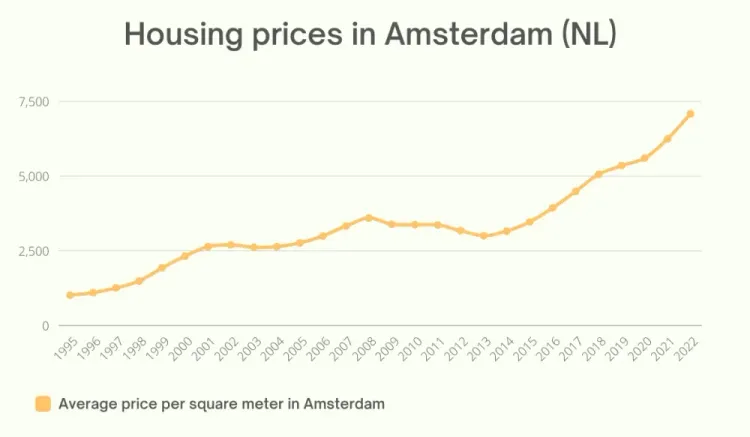
Amsterdam housing price development 1995-2026 showing the 2021-2022 peak and subsequent stabilization
Impact on the Amsterdam Rental Market
Here’s the paradox: while housing price growth has cooled, the rental market remains extremely tight. Why? Higher mortgage rates and stricter lending rules have pushed more people toward renting, increasing demand for both long-term and temporary accommodation.
Shortage of long-term rental housing
Unfurnished long-term rentals remain scarce, with waiting lists for social housing reaching 10-15 years in some Amsterdam neighborhoods. The private rental market remains highly competitive, with applicants typically needing to earn 3-4× the monthly rent to qualify.
Strong increase in demand for corporate and furnished apartments
The biggest shift since 2022 has been in corporate housing. As companies adopt hybrid work and international hiring, demand for flexible corporate rentals has increased significantly. Professionals on 6-12 month assignments now represent a larger share of Amsterdam’s rental market.
Why corporate housing demand increased:
- Remote work policies enable international placements
- Companies avoid long-term lease commitments
- Expansion of Amsterdam’s tech sector
- Shorter project-based assignments (3-9 months)
- Difficulty finding permanent housing
Benefits of furnished apartments:
- No furniture investment required
- Registration address included
- Flexible contract terms (2-12+ months)
- Utilities and internet usually included
- Available within weeks instead of months
Market insight: Furnished apartments in Amsterdam are now booked 4-6 weeks in advance during peak periods (September-November, January-March), compared to 2-3 weeks in 2022. Book early to secure preferred locations.
Mortgage Interest Rates and Market Impact
Interest rate changes have been the most important market-shaping factor since 2022.
In early 2022, a 20-year fixed mortgage could be obtained for around 1.8%. By February 2026, the same mortgage costs approximately 4.2% — an increase of 133%. For a €400,000 mortgage, this translates to roughly €700 more in monthly payments.
Higher rates have reduced how much buyers can borrow. A household earning €80,000 per year could borrow around €450,000 in 2022. In 2026, that same household qualifies for roughly €360,000 — a €90,000 reduction in borrowing capacity.
Buy-to-let investors, who were major market players during the low-interest-rate era, have largely withdrawn. Rental yields no longer justify investment at current mortgage rates.
Supply and Demand: Still Out of Balance
Despite market cooling, Amsterdam’s fundamental problem remains unchanged: there are simply not enough homes.
New construction has increased, with around 7,500-8,000 homes delivered annually in 2024-2025. While this is an improvement, it still falls short of the estimated 10,000+ homes needed annually to keep up with population growth.
What This Means for Expats and Corporate Relocations
If you are moving to Amsterdam for work or considering temporary accommodation, the housing market will significantly influence your options.
Permanent rentals remain highly competitive, often attracting 20-30 applicants per property.
For professionals staying 3-12 months, furnished apartments have become the standard solution because they bypass the competitive long-term rental market and offer flexible contracts.
Market Outlook: Predictions 2026-2027
Economists expect modest house price growth of around 2.5-3.5% annually until 2027.
The rental market should improve slightly as new housing projects are completed, though Amsterdam will likely remain a challenging rental market for at least another 3-5 years.
Demand for corporate housing and mid-term rentals is expected to remain strong as companies continue to embrace international hiring and project-based work.
Need Flexible Corporate Housing in Amsterdam?
City Retreat offers furnished apartments across Amsterdam with registration support, flexible contracts, and all-inclusive pricing.
View Available ApartmentsNavigating the Amsterdam Housing Market in 2026
The Amsterdam housing market has changed significantly since the explosive growth of 2021-2022. Although house prices have stabilized and mortgage rates have risen, demand still exceeds supply — particularly in the rental market.
For expats and professionals moving to Amsterdam, planning ahead is essential.
The good news is that the market is now more predictable than during the volatile 2021-2023 period. With realistic expectations, early planning, and flexibility regarding location, securing quality accommodation in Amsterdam is absolutely achievable.